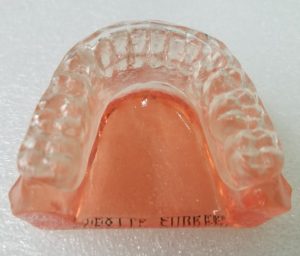
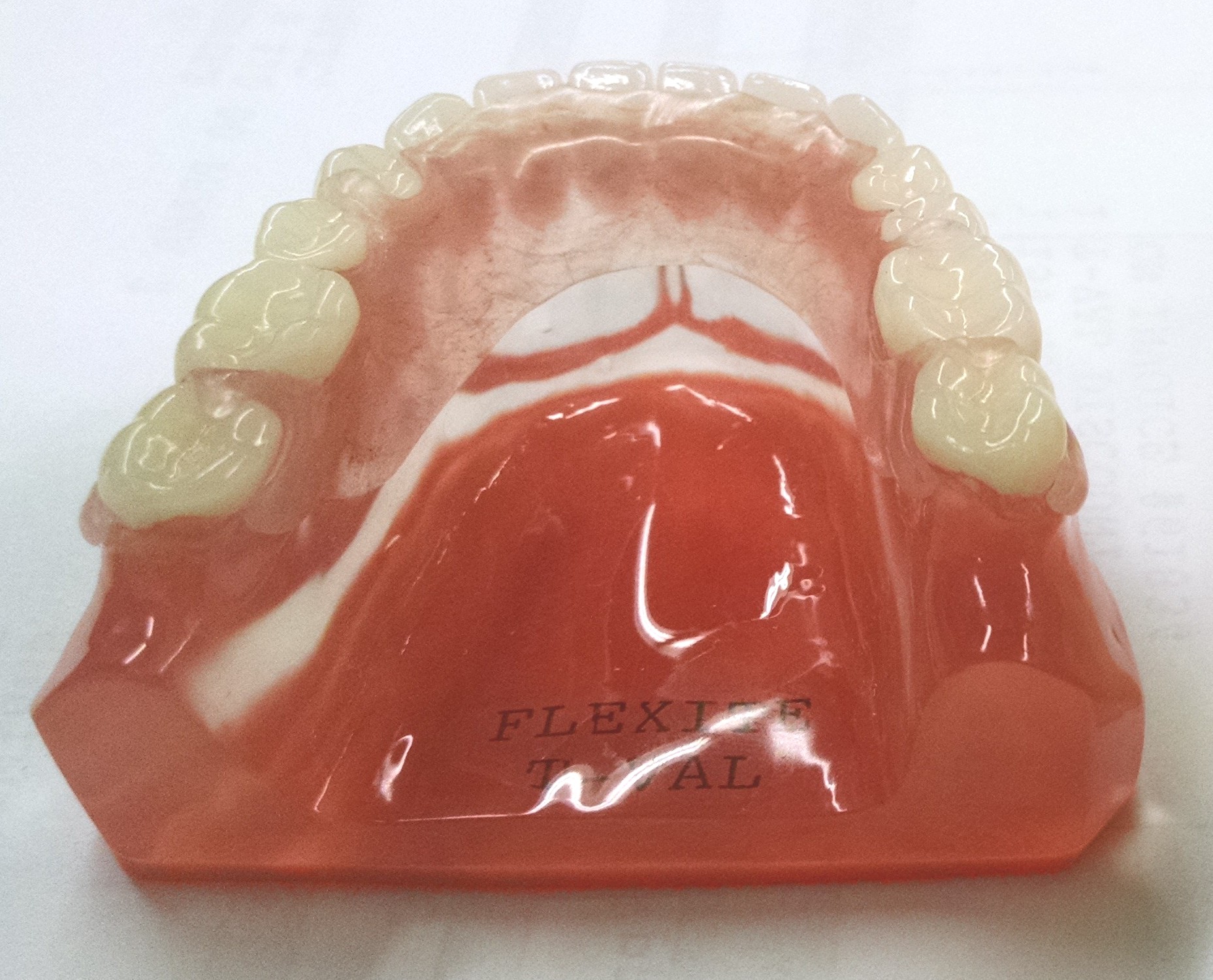
Flexil Silicone for Retentive Gaskets   

By Sol Soroca- C.D.T., President Flexite Company

Occasionally we are confronted with partials containing only 1- 4 teeth.  It is most difficult  

to obtain stability with either a flexible or metal partial under these circumstances.  We 

circumvent the problem by adding rubber gaskets around the teeth.  Acrylic-silicone combi-

nations became the standard procedure of choice.  The technique requires the silicone to 

be attached to acrylic.  If the acrylic is too thick it will be too uncomfortable for the patient.  

It could also be bulbous, unesthetic and the dentist will invariably trim it down to please the 

patient.  In many cases the acrylic fractures.  That is why we recommend Flexite MP, a semi 

flexible, multi-polymer acrylic with elastomer polymers.  The adhesion of silicone to Flexite 

MP is outstanding.  It can be thinned down without fracturing.

Case I  


The teeth and mucosa are surveyed.  Relief wax is applied allowing moderate undercuts 

to encircle the tooth near the gingival third.  A duplication is made of the model.  The 

waxed up setup is transferred from the master model to the duplicate model.  

A completed waxup is made and the case is invested in the flask using all stone.  We will 

be injecting Flexite MP into the flask.  All stone is recommended for the injection process.  

After the denture is injected and finished it is fitted to the master model and polished.  

The inside of the clasps are roughened and a binder is applied.  Silicone is then added 

inside the clasps and pressed into position.  Flexil has a two catalyst system that gives you 

the option of doing a quick cure or a regular cure.   

                                               Partial denture off the model.


              Observe the excellent esthetics with the denture seated on the model.

Note how thin the buccal clasp section is.  This cannot be obtained with conventional acrylic.


Case II

     A unique case with only two teeth remaining to support the denture. (#1 and #16)

The patient wished to retain the two molars.  The question of suction and retention with two 

posterior teeth would be a challenge.  Using the same procedure we made two gasket clasps 

around #1 and #16.   


The finished case clicked into place perfectly and held firmly without any movement.


                                             A view of the case off the model.

This result could not have been attained with metal or flexible dentures.  In the future, should 

the two molars have to be extracted, it would be easy to convert Flexite MP into a complete 

full denture because acrylic can be added directly to it.


Case III

                        Illustustration shows a lower with 4 remaining teeth. 

The gaskets would be placed around lower right cuspid and first bicuspid, (#22 And #27) and 

left cuspid and first bicuspid on the left (#22 and #21).  Using the same procedure, the the 

teeth are surveyed, blocked out in strategic areas and the model is duplicated.  The setup 

is transferred and the case is completed as previously described.     

      Anterior view of completed partial.              Occlusal view - completed partial.

For all intense and purposes, this is a full lower denture.  It will be easier for the patient to 

get used to the denture with the stabilizing gaskets. Depending on the longevity of the teeth, 

the knowledge that it could easily be converted to a full lower is reassuring to the patient 

who will not be without the denture for a longer time than is necessary.

  Summary

Cases with 1-4 teeth remaining always present retention problems and challenges. By having 

the retention encompass the entire tooth, stability is achieved by total reciprocation.  

Conventional clasping usually engage the buccal and lingual surfaces of the tooth and end up 

inadequate for these type of cases.  An alternative method has been presented for these 

unusual cases.  

CLICK HERE FOR DETAILS OF FLEXIL SOFT LINER KIT